

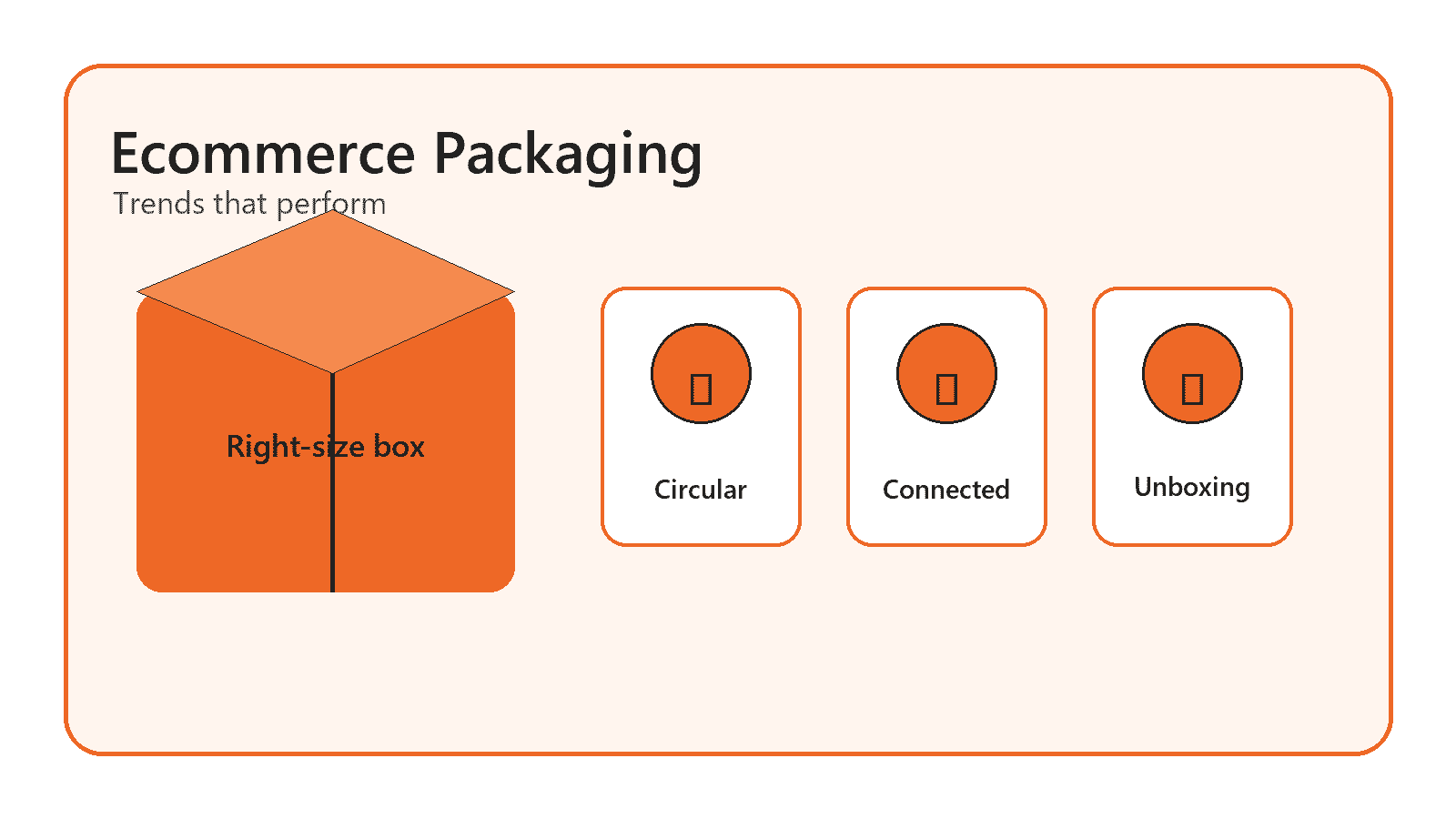
Packaging is often the first physical moment an online customer has with your brand, and it has to work harder than a pretty box. This guide explains product packaging design trends for ecommerce brands that need better shipping performance, clearer sustainability claims, stronger unboxing, and more repeatable brand recognition. By the end, you will have a practical trend filter, a refresh workflow, and a checklist for deciding which ideas deserve budget. At Optivanced, we treat packaging as both a brand asset and a conversion touchpoint, because the best ecommerce packs protect the product and make the next purchase easier.
What Are Product Packaging Design Trends for Ecommerce Brands?
A packaging trend only matters if it improves the customer experience or the business model. For ecommerce, that means the box, mailer, insert, label, and shipping workflow all need to be judged together. Retail packaging can rely on shelf presence, but ecommerce packaging also has to survive fulfillment, doorstep handling, returns, product photography, and social sharing.
That is why the smartest product packaging design trends for ecommerce brands are not just visual. They include structural choices such as right-sized boxes, paper-based cushioning, tamper evidence, easy-open tabs, return-ready closures, and packaging that can carry a shipping label without ruining the branded moment. The artwork still matters, but it sits inside a larger system.
Shopify's 2026 packaging guide frames packaging as the first in-person impression for ecommerce customers and walks through materials, concepting, pre-press, testing, and brand identity. If your current packaging feels disconnected from your wider visual system, our packaging and label design team can turn that system into artwork, dielines, labels, inserts, and product-ready assets.
Why Ecommerce Packaging Trends Matter Beyond the Box
Packaging affects more than presentation. It can influence damage rates, shipping cost, return friction, customer trust, review quality, and whether buyers share the unboxing moment. A beautiful rigid box that raises dimensional weight, arrives scuffed, or makes returns painful may be the wrong choice for a growing ecommerce brand.
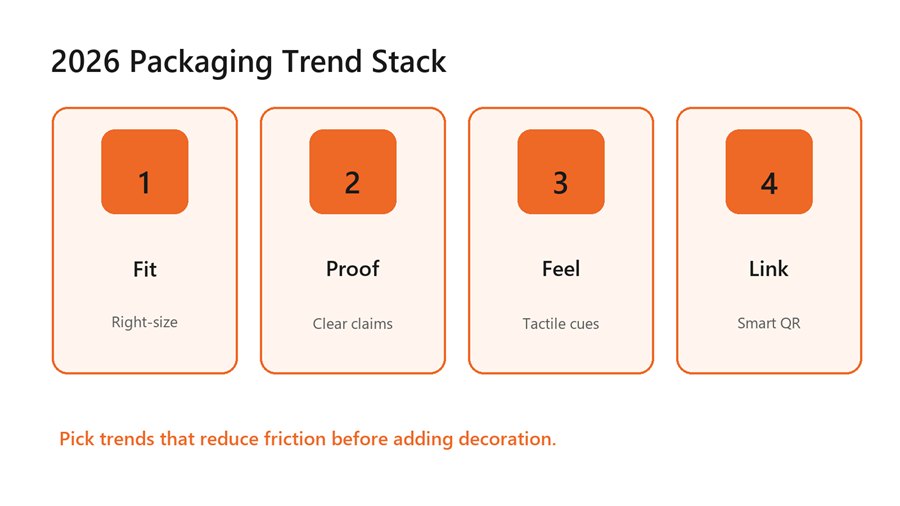
A practical 2026 trend stack for ecommerce packaging: fit,
proof, feel, and link.
The useful question is not “What is trendy?” It is “Which trend removes friction from our specific buying journey?” A premium skincare brand might need tactile finishes and refill messaging. A subscription food brand may need freshness cues, clear storage instructions, and right-sized insulation. A home goods brand may need shipping durability and an unboxing sequence that explains assembly before support tickets appear.
For brands selling through their own store, packaging should connect with product pages, returns, subscriptions, and retention campaigns. That link between packaging and store experience is why our ecommerce development team often works alongside designers when packaging changes affect bundles, subscriptions, product photography, or post-purchase flows.
Trend 1: Right-Sized Packaging Becomes a Brand Decision
Right-sizing has moved from warehouse optimization to brand experience. Customers notice oversized boxes, excessive void fill, and packaging that feels wasteful. They also notice when a package feels considered: compact, protective, easy to open, and proportionate to the product.
For ecommerce brands, right-sized design starts with order data. Look at your top SKUs, common bundle combinations, damage patterns, and return reasons. Then build packaging families around real order behavior instead of one generic carton. A smaller, better-fitted box can reduce empty space, make the unboxing feel more intentional, and simplify fulfillment training.
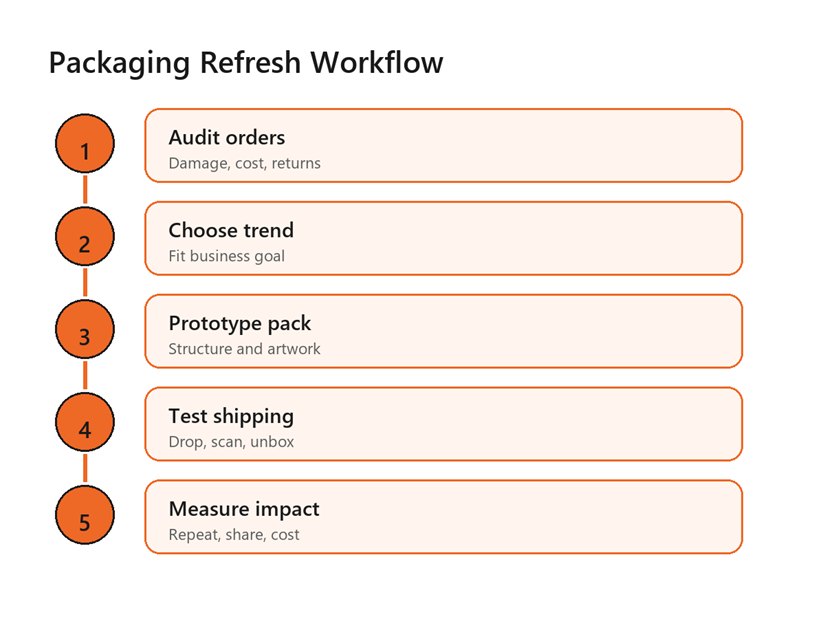
A packaging refresh should move from order audit to
prototype, shipping test, and measurement.
Amazon's Ships in Product Packaging program is one signal of this shift. Amazon describes SIPP as a way for eligible selling partners to ship customer orders in custom-brand packaging without added Amazon material. That does not mean every brand should ship in the retail box. It means structure, privacy, durability, label placement, and brand presentation now need to be designed together.
Trend 2: Sustainability Claims Get More Specific
Sustainable packaging is no longer a single look. Brown kraft paper, molded pulp, mono-material cartons, refill packs, reusable mailers, and lightweighting can all be useful, but the claim has to match the real system. A package is not automatically sustainable because it looks natural or uses a leaf icon.
The FTC's Green Guides summary says marketers should qualify recyclable claims when suitable recycling facilities are not available to at least 60 percent of the consumers or communities where the product is sold. It also warns against unqualified degradable, recyclable, recycled content, and refillable claims without the right support. For ecommerce brands, that guidance should shape both package copy and product-page language.
The practical trend is proof-led sustainability. Instead of saying “eco-friendly,” say what changed: made with 80 percent recycled paperboard, ships without plastic void fill, refill pouch available, curbside recyclable where facilities exist, or designed to reduce extra shipping material. A clear, qualified claim builds more trust than vague green language.
This is also a brand design issue. Sustainability information needs hierarchy. Put the main claim where it is visible, then use a QR code, insert, or product page for disposal instructions and sourcing details. If your brand identity needs to carry that proof without becoming cluttered, our brand identity design specialists can build the visual rules around it.
Trend 3: Tactile, Human Packaging Balances Digital Commerce
Several 2026 trend roundups point toward tactile, human, analog, and collectible design. That makes sense for ecommerce because online shopping removes touch before purchase. Packaging becomes the first chance to make the product feel material, thoughtful, and worth keeping.
Tactility does not have to mean expensive foil on every SKU. It might be a textured paper stock, a simple deboss, a tear strip with a satisfying opening motion, a printed interior pattern, or a thank-you card with a useful instruction. The goal is to create a moment that feels deliberate without adding weight, waste, or fulfillment complexity.
For ecommerce thumbnails and unboxing videos, the outer and inner faces matter. The package needs a strong read in product photos, short-form video, and customer-generated content. High contrast, legible type, simple front-panel hierarchy, and a recognizable color system help the pack perform in tiny digital contexts as well as in hand.
The key is restraint. Choose one tactile idea and one visual idea per refresh. A package with textured stock, foil, spot gloss, die cuts, busy illustration, and five claims can feel less premium than a clear box with one memorable detail.
Trend 4: Connected Packaging Turns the Box Into a Touchpoint
QR codes are back because customers now understand them, but the 2026 version is more useful than “scan for our website.” Connected packaging can route buyers to setup videos, recycling instructions, batch information, reorder pages, warranty registration, loyalty offers, ingredient sourcing, or styling ideas.
GS1 describes Digital Link as a standard that can connect a product's code to web-based, up-to-date information without changing the artwork each time the destination content changes. For ecommerce teams, that matters because packaging production cycles are slower than website updates. A connected pack lets the physical object keep pointing to current digital content.
The design rule is simple: give the scan a reason. Do not hide a QR code in a corner with no benefit. Label it with a short promise such as “Scan for setup,” “Scan for refill,” “Scan for recycling,” or “Scan for warranty.” Then make sure the landing page is mobile-fast, branded, and directly relevant. A broken scan experience makes the packaging feel gimmicky.
Connected packaging also supports retention. A refill reminder, reorder discount, care guide, or community prompt can turn a one-time purchase into a longer relationship. When that content needs social extensions, our social media post design service can translate packaging moments into campaign assets.
Trend 5: Unboxing Design Shifts From Surprise to Guidance
Unboxing used to mean tissue paper, stickers, and a thank-you card. Those can still work, but ecommerce brands are getting more practical. The best unboxing sequences now guide the buyer: what to notice first, how to use the product, what to keep, what to recycle, and what to do next.
This matters most for products with setup, sizing, assembly, care, replenishment, or multiple components. A clean opening order can prevent confusion and reduce support load. For example, the first flap might welcome the buyer, the insert might explain setup, the inner label might mark accessories, and the QR code might route to a short help page.
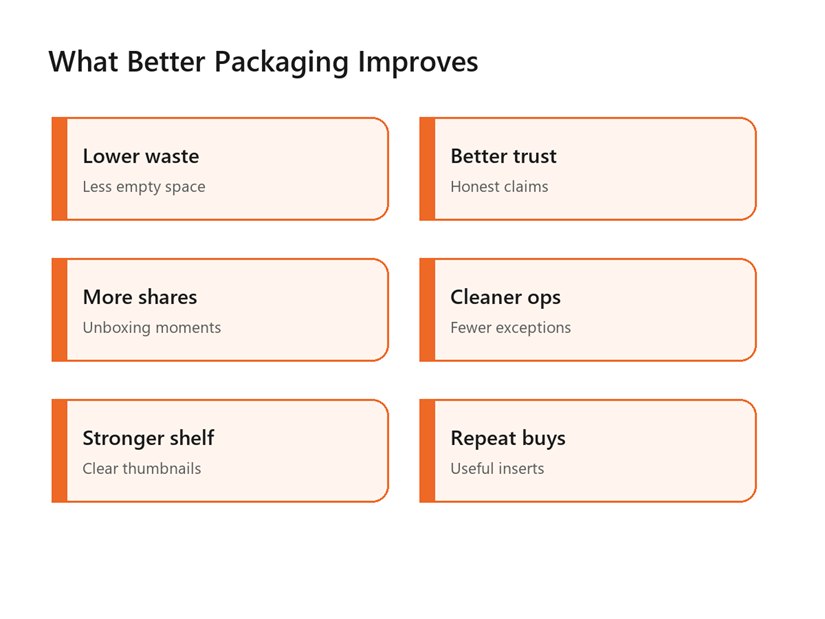
Better packaging can reduce waste, improve trust, support
unboxing, and make repeat purchase easier.
The trend is not more stuff in the box. It is more clarity. Every insert, sticker, sleeve, and printed panel should have a job. If it does not protect, explain, delight, reassure, or convert, it may be adding cost without improving the experience.
Common Packaging Trend Mistakes Ecommerce Brands Make
- Choosing a visual trend before checking shipping durability and return handling.
- Making sustainability claims that are vague, unsupported, or hard to recycle in real life.
- Designing a premium retail box that becomes scuffed when shipped directly.
- Adding QR codes without a useful mobile destination.
- Forgetting that packaging has to work in thumbnails, unboxing videos, and warehouse workflows.
- Over-customizing every SKU before testing one packaging family on top sellers.
The biggest mistake is treating packaging as a surface design project only. For ecommerce, structure and artwork are tied together. If the structure fails, the artwork arrives damaged. If the artwork fails, the structure may protect the product but do little for trust, recall, or repeat purchase.
Another mistake is following too many product packaging design trends for ecommerce brands at once. A single refresh should have a business reason: reduce waste, improve unboxing, clarify sustainability, support gifting, improve marketplace readiness, or raise perceived value. When the reason is clear, the design choices get sharper.
A Practical Trend Filter for Your Next Packaging Refresh
Use a simple filter before adopting any trend. First, define the operational problem: damage, cost, unboxing confusion, weak shelf presence, low repeat purchase, unclear disposal, or poor marketplace readiness. Second, match the trend to that problem. Third, prototype with real products, real inserts, real labels, and real shipping conditions. Fourth, measure the result before expanding the system.
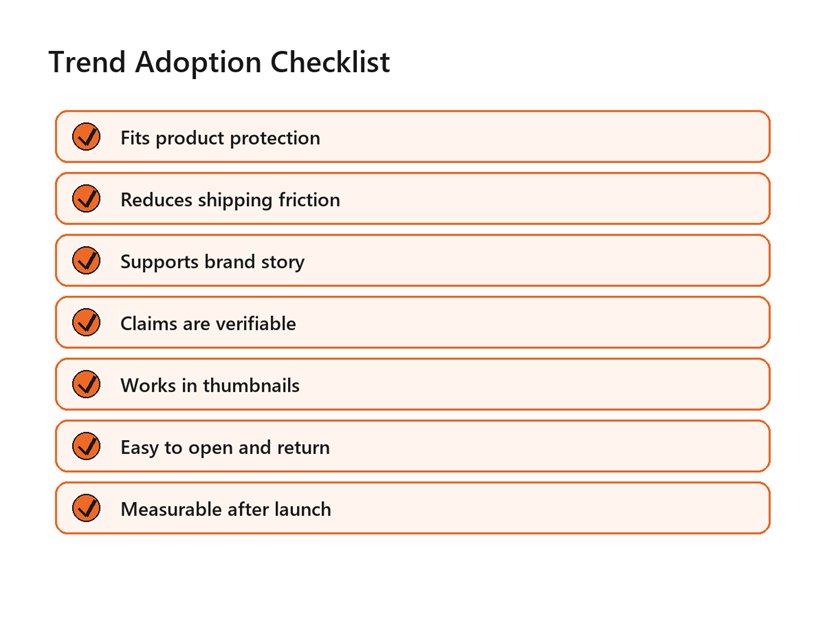
A checklist for deciding which packaging trends deserve
budget.
Good packaging metrics include damage rate, average package volume, fulfillment time, return reason, customer support tickets, reorder rate, review mentions, social shares, and cost per shipped order. Creative teams should see those numbers, not just mood boards. Data keeps the design conversation honest.
This is the practical promise of product packaging design trends for ecommerce brands: not a prettier box for its own sake, but a packaging system that protects margins, supports brand trust, and makes customers feel confident after checkout. The best trend is the one your buyers notice for the right reason.
When product packaging design trends for ecommerce brands are reviewed this way, the team can separate useful change from cosmetic noise. It also gives founders, designers, suppliers, and fulfillment partners the same scorecard before money is spent on tooling or a large print run.
Use that scorecard quarterly. Product packaging design trends for ecommerce brands move quickly, but your packaging system should evolve with evidence, not panic.
FAQs
What packaging trends matter most for ecommerce brands in 2026?
The most practical trends are right-sized packaging, proof-led sustainability, tactile brand cues, connected QR experiences, and guided unboxing. These ideas help ecommerce packaging do more than look attractive. They improve shipping, trust, instructions, repeat purchase, and customer perception.
How do I choose sustainable packaging without greenwashing?
Start with a specific material or system change, then make only claims you can support. Avoid broad phrases like eco-friendly. Use qualified language around recyclability, recycled content, compostability, and refillability, and make disposal instructions easy to find on-pack or through a QR code.
Is custom packaging worth it for a small ecommerce brand?
Custom packaging can be worth it when it solves a real problem or improves repeat purchase. Start with top-selling SKUs, branded labels, inserts, or right-sized mailers before investing in complex structures. Test damage, cost, reviews, and reorder behavior before scaling.
Should ecommerce packaging be designed for unboxing videos?
Yes, but not at the expense of protection or cost. Design a clear opening sequence, readable interior message, and one memorable branded detail. The package should photograph well, explain the product, and still be easy to recycle or return.
How often should an ecommerce brand refresh packaging?
Refresh packaging when there is a business reason: a new product line, cost issue, sustainability update, marketplace requirement, brand repositioning, or recurring customer confusion. Minor artwork updates can happen seasonally, but structural changes should be tested carefully.
External Links Referenced
Ecommerce packaging design process: Shopify product packaging design guide
Environmental claims guidance: FTC Green Guides summary
Connected packaging standard: GS1 Digital Link
Marketplace packaging program: Amazon Packaging SIPP FAQs
Final Thoughts
Packaging trends are useful only when they make the customer experience clearer and the operation stronger. The ecommerce brands that win with packaging in 2026 will choose fewer trends, test them harder, and connect the box to the full post-purchase journey. The mistake to avoid is buying a fashionable finish before proving the structure, claim, and unboxing path. If you would rather not build this from scratch, our team at Optivanced does it every week through custom packaging and label design. Want a custom plan for your business? Get a free quote and we will send you a tailored proposal within one business day.