

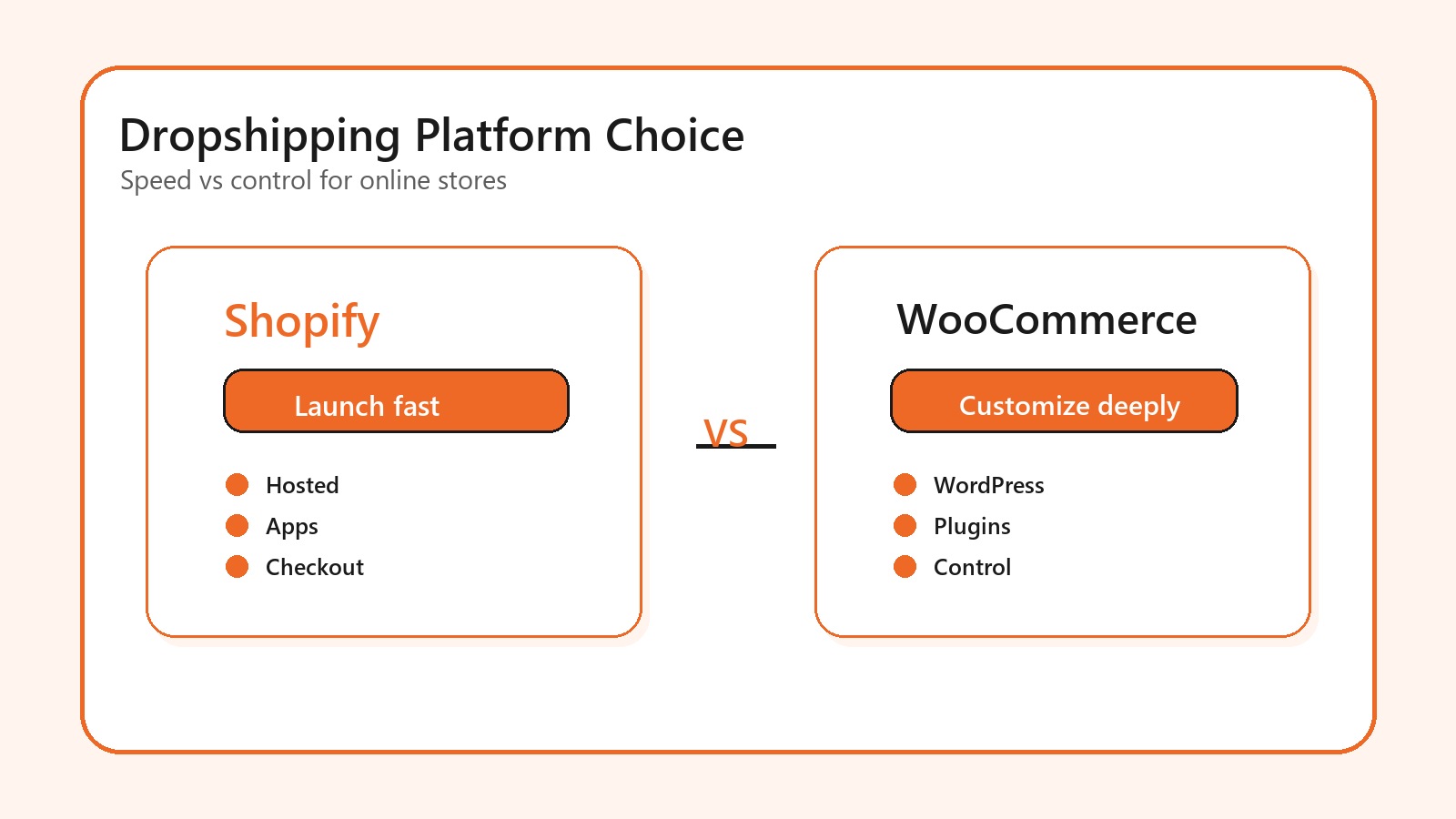
Choosing a platform too early can trap a dropshipping store in the wrong cost structure, app stack, or maintenance routine. This guide compares Shopify vs WooCommerce for dropshipping stores in plain business terms: launch speed, supplier integrations, payment flexibility, SEO, customization, operations, and long-term control. By the end, you will have a decision framework, a cost checklist, and a practical build path for testing products without creating a fragile store. At Optivanced, we treat platform choice as an operating decision, not a brand preference.
Table of Contents
Right-click and choose 'Update Field' to populate the table of contents.
What This Comparison Really Means for Dropshippers
Shopify and WooCommerce can both run a serious dropshipping business. The difference is how much work the platform handles for you, and how much control you want over the store stack. Shopify is a hosted commerce platform: storefront, checkout, admin, app marketplace, hosting, security, and many operational tools live in one system. WooCommerce is an open-source commerce plugin for WordPress, so the store depends on your hosting, theme, plugins, payment gateways, and technical maintenance choices.
That difference matters more in dropshipping than in many other ecommerce models. Dropshippers rely on supplier sync, product import, order routing, tracking updates, payment acceptance, customer communication, and fast testing. A platform that saves setup time can help you validate products quickly. A platform that gives deeper control can help you build a content-led or highly customized store that is harder to copy.
Shopify's own help center defines dropshipping as selling products without storing inventory or shipping the products yourself, with suppliers shipping to customers on your behalf. Shopify also warns that merchants are still responsible for product safety, refunds, processing timeframes, and compliance when they dropship. That is the right frame for this comparison: the platform can help operations, but it does not remove merchant responsibility.
Source: Shopify Help Center on dropshipping for the fulfillment model definition.
Source: Shopify legal guidance for dropshipping for product safety, refunds, and compliance responsibilities.
Shopify vs WooCommerce for Dropshipping Stores: Quick Verdict
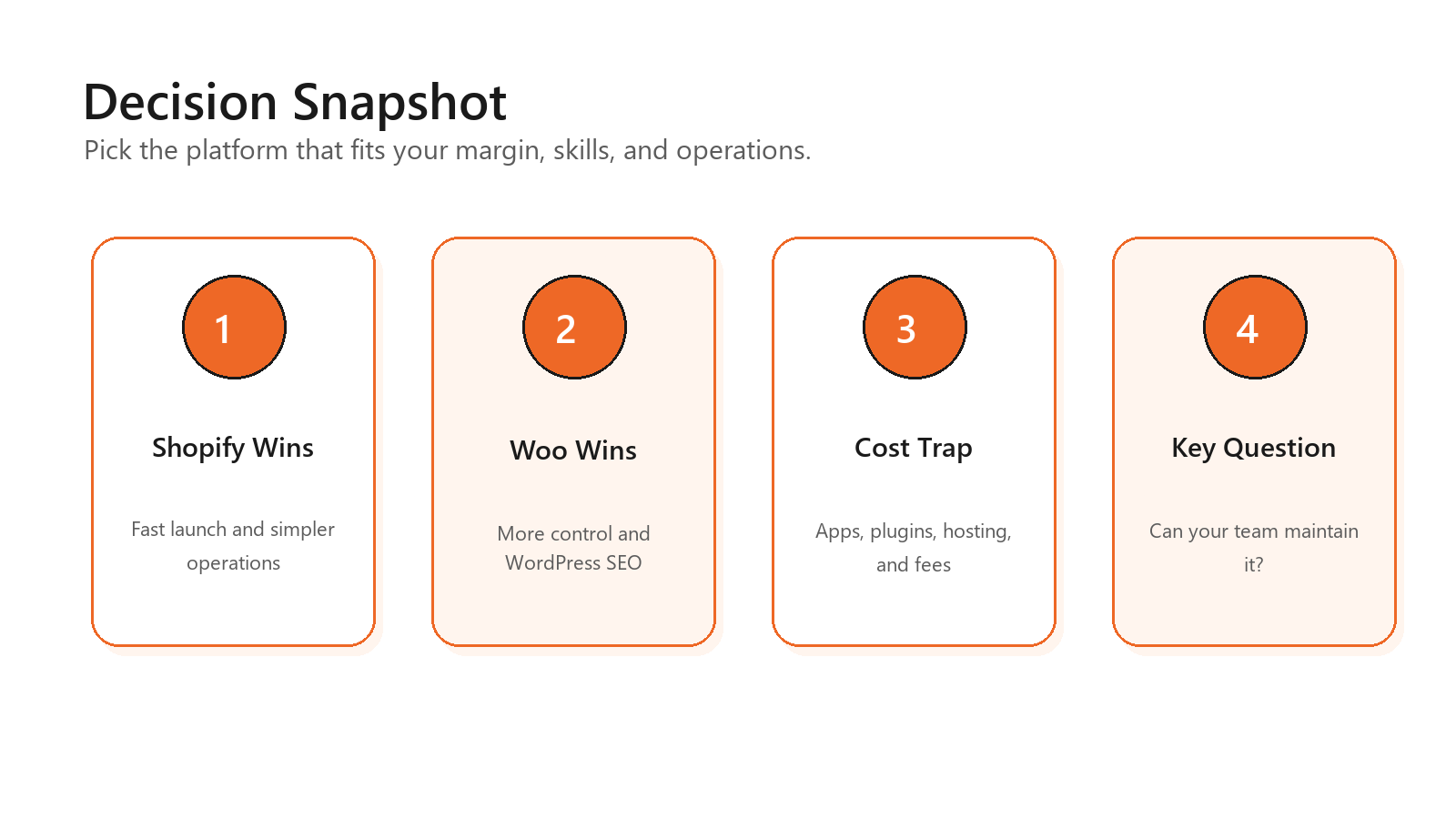
The platform decision is less about which tool is better and more about speed, control, costs, and team capability.
For most first-time dropshippers, Shopify is the cleaner starting point. It reduces technical decisions, has a mature commerce admin, offers a large app ecosystem, and makes it easier to launch a product test quickly. That does not mean it is always cheaper. Apps, themes, payment rules, and plan upgrades can still eat margin. But Shopify usually lets a nontechnical founder spend more time on product testing, creatives, supplier vetting, and customer support.
WooCommerce is strongest when the store owner already understands WordPress, wants deeper customization, cares heavily about content and SEO, or needs payment and checkout flexibility that a closed platform may not support. It can be cheaper at the platform layer, but that savings only matters if hosting, maintenance, plugins, security, and developer time are managed well. A poorly maintained WooCommerce store can become more expensive than Shopify because the hidden cost is attention.
If you want a store built around practical margin, supplier flow, and customer experience, Optivanced can help through e-commerce development that compares the platform choice before the build starts.
The short version: choose Shopify when speed, simplicity, and operational consistency matter most. Choose WooCommerce when control, custom workflows, WordPress content, or unusual payment needs matter more than convenience. That is the practical heart of Shopify vs WooCommerce for dropshipping stores: one path reduces setup work, while the other rewards teams that can manage more moving parts.
Head-to-Head Comparison: Cost, Apps, SEO, Payments, and Control
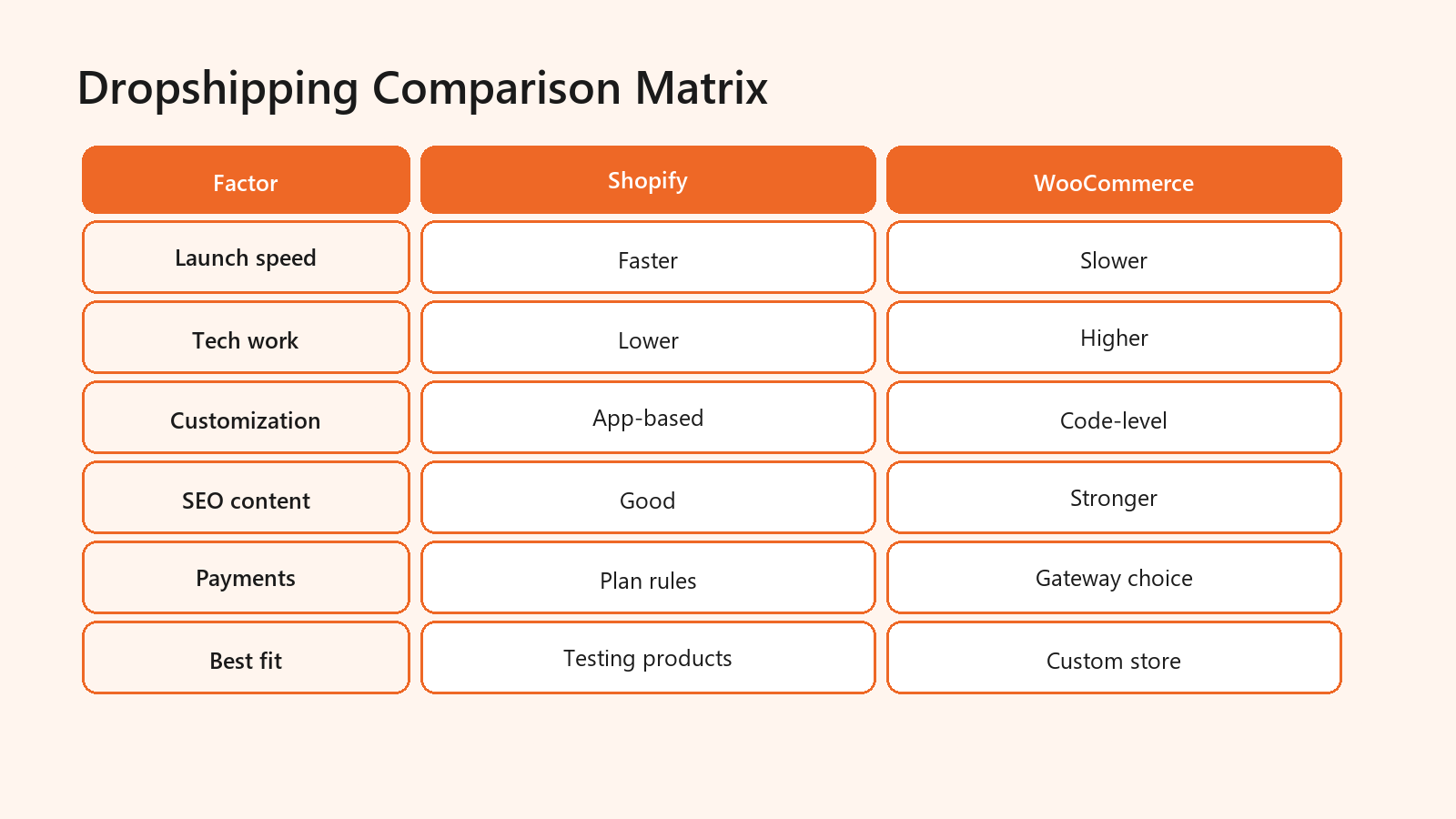
Shopify usually wins on speed and simplicity; WooCommerce usually wins on control and WordPress flexibility.
Cost is the first question, but it is rarely as simple as monthly plan versus free plugin. Shopify charges a subscription and may charge third-party transaction fees when merchants use external payment providers. Shopify's help center states that Basic, Grow, and Advanced plans have monthly price, credit card rate, and third-party transaction fee differences, and that current rates should be reviewed by region. WooCommerce is open source, but a real store still needs hosting, SSL, a theme, extensions, backups, security, and sometimes developer support.
Source: Shopify pricing and billing overview for plan, rate, and transaction fee categories.
App and plugin risk is the second cost layer. Shopify apps are usually easier to install and connect, which helps when you need product sourcing, reviews, subscriptions, bundles, upsells, tracking, and email. WooCommerce plugins can be more flexible, but every plugin adds maintenance risk. Dropshipping stores often stack supplier tools, review apps, analytics scripts, trust badges, currency tools, and email integrations. The question is not whether the feature exists. It is whether the stack remains stable as the store grows.
SEO is more nuanced. WooCommerce sits on WordPress, which is a strong base for content marketing, editorial workflows, custom schema, internal linking, and long-tail search pages. Shopify can rank well too, especially when the store is structured cleanly and content is built intentionally. WooCommerce gives more control over the content system; Shopify gives a simpler commerce workflow. For dropshippers who depend on paid traffic and quick product tests, Shopify may be enough. For niche stores built around guides, comparisons, and organic traffic, WooCommerce can be a better strategic fit.
Payments can be decisive. Shopify's system is smooth when Shopify Payments fits your country, product type, and risk profile. WooCommerce says WooPayments is not required and that WooCommerce can use many payment gateways. That flexibility matters if you sell in regions, categories, or business models where one gateway is not enough. The tradeoff is that more gateway choice means more setup and more responsibility.
Source: WooCommerce payment gateway guidance on WooPayments and gateway flexibility.
When Shopify Is the Better Dropshipping Platform
Shopify is usually the better option when your main goal is to test products fast. A beginner can pick a theme, connect a supplier app, add products, configure checkout, and start learning from traffic without managing hosting or WordPress updates. In dropshipping, speed to learning matters because the first product is rarely the final winner.
Shopify also fits teams that want an easier admin experience. Order management, abandoned checkout tools, analytics, customer records, product setup, and fulfillment workflows are built for commerce first. If a virtual assistant or nontechnical founder must manage daily operations, the simpler dashboard can reduce mistakes. That is valuable when customer service, returns, refunds, and tracking updates already create enough work.
The platform is especially useful for ad-led dropshipping. Paid social and search campaigns reward fast iteration. You can test product pages, landing pages, bundles, creatives, and post-purchase flows without waiting on deep custom development. Shopify also has a large ecosystem of dropshipping, print-on-demand, review, upsell, fulfillment, and email apps, which gives beginners a shorter path to a working stack.
If your plan depends on speed, product testing, and paid traffic, pair the store with Google and social media ads so campaign structure, product pages, and tracking are built around the same test plan.
The downside is that convenience can become dependency. Apps can increase monthly cost. Theme limitations can shape design decisions. Advanced checkout customization may require higher plans or workarounds. If your store's competitive advantage depends on a custom buying flow, unusual product logic, or a deeply differentiated content experience, Shopify may start to feel boxed in.
When WooCommerce Is the Better Dropshipping Platform
WooCommerce is the stronger choice when the store is part of a broader WordPress strategy. If your brand plans to publish buying guides, comparison pages, niche education, affiliate content, or SEO-heavy product research, WordPress gives deep editorial control. You can build custom templates, category hubs, internal links, schema, and content workflows around the store instead of treating content as an add-on.
WooCommerce also makes sense for technical founders or teams with developer support. You can customize checkout, add custom product fields, connect unusual APIs, build private supplier workflows, and control hosting decisions. That flexibility can be powerful for stores that need something beyond a standard product page and checkout.
Optivanced often treats WooCommerce as a good fit when the project also needs CMS development, custom content architecture, and long-term control over the site structure.
The tradeoff is maintenance. WooCommerce stores need updates, backups, security attention, plugin compatibility checks, performance tuning, and hosting decisions. A dropshipping store with a dozen plugins can become fragile if nobody owns the technical stack. The cheaper path on paper can become expensive when a plugin conflict breaks checkout during a product launch.
That is why WooCommerce is not simply the budget option. It is the control option. If you have the skill, process, or agency support to manage that control, it can be excellent. If you do not, Shopify may be the safer commercial choice. In client planning, Shopify vs WooCommerce for dropshipping stores usually becomes a question of who will maintain the store after the first launch sprint.
Business Model Fit: How to Choose Without Guessing
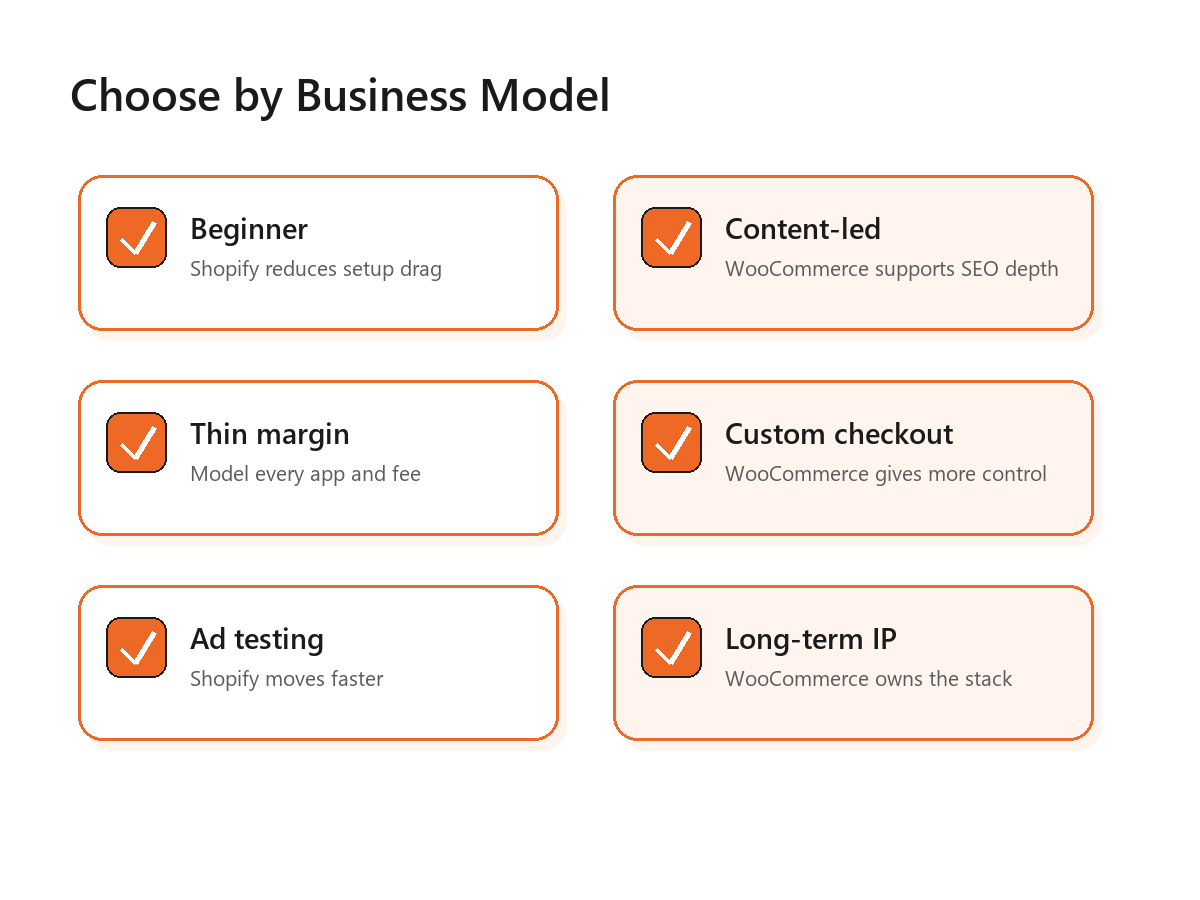
The right platform depends on whether you are testing fast, building content depth, protecting margin, or customizing operations.
A simple decision matrix beats platform loyalty. Choose Shopify if you are new, paid-traffic-led, testing many products, using common supplier apps, and need a store that is easy to run. Choose WooCommerce if you are content-led, technically comfortable, payment-sensitive, or building a store where custom workflows matter.
Margin should be modeled before design begins. Dropshipping margins can be thin because the supplier handles fulfillment and takes a meaningful share of the unit economics. Shopify's official 2026 dropshipping guide describes the model as lower in operating overhead but often lower in profit margin than traditional ecommerce. That means platform fees, app subscriptions, payment fees, returns, refunds, and ad costs must all be included in the decision.
Source: Shopify's 2026 dropshipping guide for model definition, supplier role, and margin context.
For a low-ticket product, every fixed fee matters. For a premium product with stronger margin, the bigger question may be conversion rate, trust, and speed to market. For a niche content brand, organic traffic may matter more than launch speed. For a store that sells in multiple countries, gateway support and compliance may decide the platform before design does.
If you want help modeling both build paths, our custom website development team can scope Shopify and WooCommerce versions before you commit to one stack.
Common Mistakes Dropshippers Make With Both Platforms
The first mistake is choosing a platform before choosing an operating model. A one-product testing store, a niche content store, a branded product collection, and a multi-supplier catalog do not need the same stack. The right question is not 'Which platform is better?' It is 'Which platform helps this business model learn, sell, and recover from problems faster?'
The second mistake is ignoring supplier quality. Neither Shopify nor WooCommerce can fix unreliable shipping, poor product quality, weak packaging, confusing tracking, or bad return policies. Platform choice supports operations, but supplier vetting protects the customer experience.
The third mistake is underestimating maintenance. Shopify stores still need app audits, tracking checks, theme updates, conversion testing, and fraud review. WooCommerce stores need all of that plus hosting, plugin, and security discipline. The store should have an owner for uptime, checkout health, analytics, and supplier sync.
For either platform, ongoing website maintenance and security support keeps product tests from being derailed by broken forms, slow pages, expired integrations, or checkout errors.
The fourth mistake is treating the store as the entire business. A dropshipping store also needs ad creative, product research, customer service scripts, refund rules, email flows, analytics, and landing pages. A platform can make those pieces easier, but it cannot replace the operating system around them.
Final Platform Checklist Before You Build
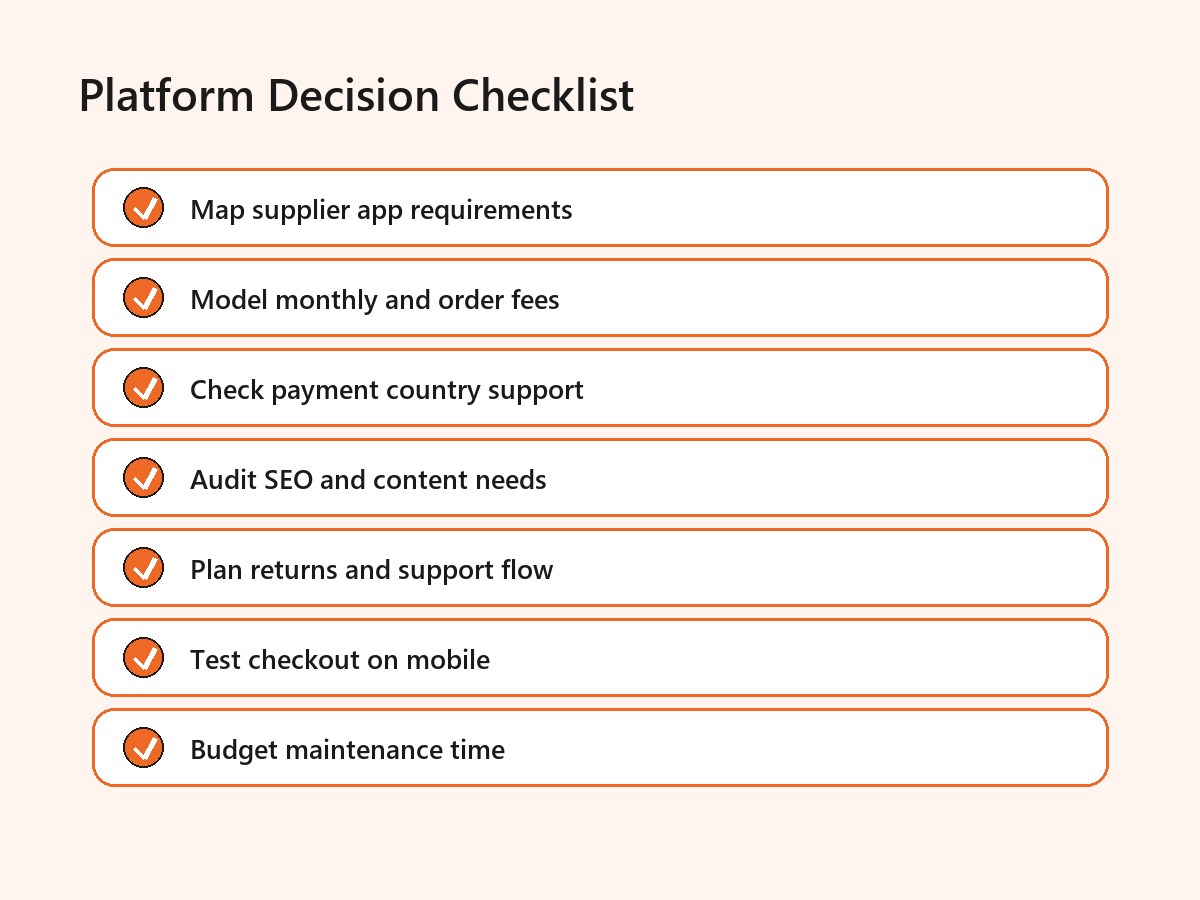
Before choosing Shopify or WooCommerce, check supplier apps, total cost, payments, SEO, returns, mobile checkout, and maintenance needs.
Use this checklist before paying for themes, apps, plugins, or development. It helps separate real requirements from platform opinions.
List the supplier apps or APIs you need, then confirm support for Shopify and WooCommerce.
Model subscription, hosting, app, plugin, payment, developer, and maintenance costs for the first 12 months.
Check whether your preferred payment gateways support your country, product category, and risk profile.
Decide whether paid ads, organic SEO, or email will be the main traffic source.
Map the refund, return, shipping, tracking, and customer support workflow before launch.
Test mobile product pages and checkout flow with real devices.
Assign responsibility for updates, backups, analytics, app audits, and supplier sync.
If Shopify wins the checklist, build lean and test quickly. If WooCommerce wins, invest in a stable technical foundation before scaling traffic. The best platform is the one that lets your team sell, learn, and serve customers without creating avoidable operational drag.
For campaign-specific pages around your first winning products, add landing page and sales funnel development so your store is not relying only on standard product pages to convert traffic.
External Links and Sources
Platform source: Shopify Help Center on dropshipping
Compliance source: Shopify legal guidance for dropshipping
Pricing source: Shopify pricing and billing overview
Payment source: WooCommerce gateway guidance
FAQs
Is Shopify better than WooCommerce for beginner dropshippers?
Usually, yes. Shopify is easier to launch, easier to operate, and less technical for a first product test. A beginner can focus on products, ads, creatives, and customer service instead of hosting and plugin maintenance. WooCommerce can still work if the founder already knows WordPress or has technical support.
Is WooCommerce cheaper than Shopify for dropshipping?
It can be cheaper at the platform layer, but not automatically. WooCommerce still needs hosting, extensions, security, backups, performance work, and sometimes developer support. Shopify has clearer platform costs, but apps, payment rules, and plan upgrades can add up. Model the total 12-month cost before deciding.
Which platform is better for dropshipping SEO?
WooCommerce often gives more control for content-led SEO because it runs on WordPress. Shopify can rank well too, especially with clean product pages and strong collection structure. If organic guides and niche content are central to the business, WooCommerce has an edge. If paid traffic drives the store, Shopify may be enough.
Can I migrate from WooCommerce to Shopify later?
Yes, but migration takes planning. Products, images, customers, orders, URLs, redirects, email flows, analytics, and app logic all need review. The move is easier if your data is organized from the beginning. Avoid building messy product taxonomies or plugin-dependent workflows you cannot recreate.
Which platform is better for supplier integrations?
Shopify usually has a broader beginner-friendly dropshipping app ecosystem. WooCommerce can integrate with many suppliers too, especially through plugins or custom APIs, but setup may require more technical work. Always check the exact supplier tool before choosing the platform.
What is the safest recommendation for a new dropshipping store?
If the goal is fast product testing with limited technical skill, start with Shopify. If the goal is a content-heavy niche brand, custom checkout, or deeper ownership of the stack, consider WooCommerce. The safest choice is the one your team can maintain while still testing products quickly.
Final Thoughts
Shopify is usually the practical launch platform for fast dropshipping tests. WooCommerce is usually the stronger control platform for teams that can manage WordPress, SEO content, and custom workflows. The most common mistake is picking the cheaper-looking option without modeling apps, plugins, payments, maintenance, and the team's actual technical capacity.
If you would rather not build this from scratch, our team at Optivanced can compare the stack and build the store through e-commerce development. Want a custom plan for your business? Get a free quote and we will send you a tailored proposal within one business day.
Need help choosing, building, and optimizing the right dropshipping store platform? Get a free quote and we will send a practical platform plan within one business day. |